
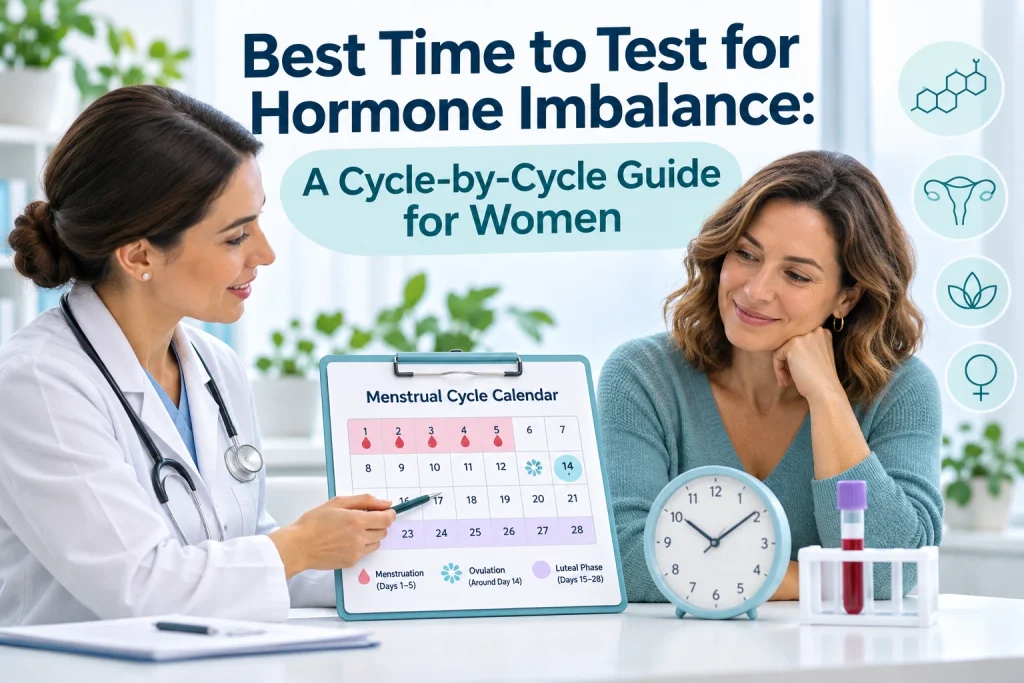
The best time to test for hormone imbalance depends on which hormone you’re checking.
FSH and estrogen are most accurate on days 2 to 5 of your cycle, progesterone on days 19 to 21, and testosterone, cortisol, and thyroid hormones in the morning on any day.
Irregular cycles, perimenopause, postpartum recovery, and birth control all shift this window, so matching the test to your body matters more than the calendar date alone.
You finally scheduled the hormone test you’d been asking your doctor for.
Then the results came back normal, even though nothing about how you feel is normal.
This happens more often than most women realize, and the problem usually isn’t the test itself.
It’s the timing.
The best time to test for hormone imbalance depends on which hormone you’re checking, where you are in your cycle, and what life stage you’re in.
Test on the wrong day, and even a real imbalance can look like a normal result.
This guide walks through exactly when to test each hormone, what changes if your cycle is irregular or you’re in perimenopause, and which symptoms mean you shouldn’t wait for a “perfect” day to get checked.
What Is the Best Time to Test for Hormone Imbalance?
For women with a regular cycle, the best time to test for hormone imbalance is early in the cycle, days 2 to 5, for FSH and estrogen, and in the mid-luteal phase, days 19 to 21, for progesterone.
Testosterone, cortisol, and thyroid hormones are most accurate when tested in the morning, ideally before 10 a.m., regardless of the cycle day.
Hormones aren’t a fixed number you carry around all month.
Estrogen, progesterone, FSH, and LH all rise and fall as your body moves through ovulation, and a single blood draw only captures that one moment.
FSH testing is typically done on day 3 of the cycle because that’s when levels sit at their most stable baseline, before the hormonal shifts leading up to ovulation begin.
Progesterone works the opposite way.
It barely registers early in the cycle and only rises after ovulation, so testing it on day 3 would show a falsely low result even in a woman with completely normal hormone function.
Why Does Timing Change the Result So Much?
Hormones are controlled by feedback loops that shift hour to hour and day to day.
Cortisol can be several times higher right after waking than it is by evening, and progesterone can swing from barely detectable to its peak within a single week of the menstrual cycle.
Testing outside the right window can make a healthy hormone level look abnormal, or hide a real imbalance entirely.
This is also why two women with identical symptoms can get completely different lab results on the same day.
One might be tested at the point her hormones naturally peak, and the other at the point they naturally dip, even though both are following the same monthly pattern.
The Best Cycle Day to Test Each Hormone
If your cycle shows up on a fairly predictable schedule, here’s when to test each hormone for the clearest picture.
FSH and LH: Day 2-5
Follicle-stimulating hormone (FSH) and luteinizing hormone (LH) are both best measured early in the cycle, days 2 through 5, counting day 1 as the first day of full bleeding.
This is your hormonal baseline, before your ovaries start preparing an egg for that month.
An elevated FSH level tested during this window can point toward declining ovarian reserve or perimenopause, while a normal result here doesn’t rule out imbalance later in the cycle.
Estrogen: Day 2-3 and Day 19-21
Estrogen matters at two different points.
Testing on day 2 or 3 shows your baseline estradiol, which is useful alongside FSH for assessing ovarian reserve.
Testing again around day 19 to 21 shows how well your body is producing estrogen after ovulation, which is the number most relevant to symptoms like hot flashes, night sweats, and mood changes.
Progesterone: Day 19-21
Progesterone should be tested about a week after ovulation, which lands around day 19 to 21 for a typical 28-day cycle.
This is the mid-luteal phase, when progesterone peaks if ovulation happened normally.
Mayo Clinic Laboratories considers a mid-luteal progesterone level above 10 ng/mL evidence that ovulation occurred, so a lower number can mean either an ovulation problem or a test drawn on the wrong day.
Testosterone, Cortisol, and Thyroid: Morning, Any Day
Testosterone, cortisol, and thyroid hormones don’t follow the menstrual cycle the way estrogen and progesterone do.
Instead, they follow a daily rhythm.
Testosterone and cortisol are both highest shortly after waking and decline through the day, so morning testing before 10 a.m. gives the most accurate read.
Thyroid hormones stay more stable throughout the day, but morning testing is still standard since it’s easiest to pair with a fasting blood draw.
For a closer look at what each of these tests involves and how results are reported, a comprehensive hormone panel covers blood, saliva, and urine testing options in more detail.
What If Your Periods Are Irregular or Absent?
If your cycle is irregular, unpredictable, or absent due to perimenopause, PCOS, or recent childbirth, cycle-day testing doesn’t apply the same way.
Most providers recommend testing on a flexible schedule instead, sometimes repeating tests every few weeks, to capture a pattern rather than a single snapshot.
Trying to pin an irregular cycle to “day 21” usually backfires, because you can’t know when ovulation happened, or if it happened at all.
During perimenopause, estrogen and progesterone can swing unpredictably from one cycle to the next, which is exactly why a single test often doesn’t tell the full story.
For women without periods at all, whether from menopause, certain birth control methods, or a medical condition, hormone levels can typically be checked on any day, since there’s no cycle pattern to time around.
Best Time to Test by Life Stage
Let’s look at how the best time to test may differ across different life stages:
Perimenopause
Perimenopause symptoms often show up years before periods actually stop, and hormone levels can look completely normal on any single day even when a woman is deep in the transition.
If your periods are still fairly regular, testing FSH and estrogen on day 2 to 5 is still useful, but expect more variation from month to month than you’d see in your twenties or thirties.
Tracking symptoms alongside when perimenopause symptoms typically begin often tells a clearer story than one lab result alone.
Postpartum
Hormones don’t reset to a predictable cycle right away after pregnancy, especially while breastfeeding.
Prolactin, the hormone that supports milk production, suppresses estrogen, which can cause symptoms that look identical to low estrogen long after delivery.
Testing is usually most useful once periods return or symptoms persist well beyond the typical postpartum recovery window, rather than in the first few weeks after birth.
PCOS
Polycystic ovary syndrome (PCOS) often comes with irregular or absent ovulation, which throws off standard cycle-day timing.
Testosterone, LH, and FSH are usually checked together, often with an LH-to-FSH ratio in mind, and can typically be drawn whenever a woman isn’t on hormonal birth control.
Because PCOS changes how hormone therapy is approached, getting an accurate baseline matters before starting any treatment.
On Birth Control
Hormonal birth control suppresses your natural cycle, so standard cycle-day testing won’t give an accurate picture of your own hormone production while you’re on it.
Most providers recommend waiting until you’ve been off hormonal birth control for at least one full cycle before testing, so your body has time to return to its own pattern.
Which Symptoms Mean You Shouldn’t Wait to Test?
Certain symptoms are worth testing for right away rather than waiting for a specific cycle day: persistent fatigue, unexplained weight changes, hair loss, joint pain, low libido, hot flashes, brain fog, and mood swings that don’t match your normal pattern.
A provider can often still get useful information even outside the ideal testing window, and waiting months for the “right” day isn’t worth it if symptoms are affecting your daily life.
Some of the most overlooked signs of hormone imbalance aren’t the ones people expect.
Joint pain that shows up without an injury and hair thinning that seems to come out of nowhere can both trace back to shifting estrogen levels.
So can low estrogen symptoms like vaginal dryness, trouble sleeping, and a sex drive that’s noticeably lower than it used to be.
If you’re noticing a cluster of these changes, that’s usually a clearer signal than any single number on a lab report.
Recognizing the signs that point toward hormone replacement therapy is often more useful than fixating on hitting a perfect testing day.
What Should You Do Before a Hormone Test?
To get the most accurate hormone test results, track your cycle for at least one full month before testing, schedule your blood draw for the morning when possible, avoid starting new supplements right before the test, and tell your provider about any birth control, illness, or major sleep changes that could affect your levels.
- Track your cycle for at least one month so you can count cycle days accurately, since day 1 is the first day of full bleeding, not spotting.
- Schedule your draw in the morning whenever a provider gives you a choice, since several hormones peak early in the day.
- Hold off on starting new supplements, especially biotin, in the days before testing, since it can interfere with certain lab results.
- Tell your provider about any hormonal birth control, recent illness, or major stress, since all three can temporarily shift your levels.
- Mention poor sleep in the days leading up to your test, since it affects cortisol more than most people expect.
How Women’s Wellness of Mississippi Makes Hormone Testing Simple
Figuring out the right day to test is only half the challenge.
The other half is finding a provider who will actually walk you through what the numbers mean.
At Women’s Wellness of Mississippi, every new patient starts with a full lab panel and consultation through our hormone replacement therapy program, timed to your cycle whenever possible, so you and your provider can go over the results together.
Women across Madison, Ridgeland, and the greater Jackson area come to us because testing day confusion shouldn’t be the reason an imbalance goes untreated for another year.
If your results point toward something unrelated to hormones, our primary care team can take it from there.
If they point toward starting hormone replacement therapy, we build the next step around what your actual labs and symptoms show, not a one-size-fits-all protocol.
What Happens After You Get Your Results?
A hormone test result is a starting point, not a diagnosis on its own.
A good provider interprets your levels alongside your symptoms, cycle history, and life stage, then recommends either a treatment plan, a repeat test at a better-timed window, or monitoring over the next few cycles if the picture isn’t clear yet.
Normal ranges on a lab report are built from a wide population, which means a number can sit inside the “normal” range and still be wrong for you personally.
If your current treatment isn’t working the way it should, that’s usually a sign your plan needs adjusting, not that hormones aren’t the issue after all.
Retesting isn’t a failure.
Hormones shift with stress, weight changes, new medications, and simply getting older, so most providers expect to recheck levels every few months to a year, depending on what’s being treated.
FAQs
Can I test my hormones while on birth control?
Hormonal birth control suppresses your natural hormone production, so testing while on it usually reflects the medication rather than your own baseline. Most providers recommend waiting until you’ve been off hormonal birth control for at least one full cycle before testing for an accurate picture.
What’s the best time of day to test hormones?
Morning, generally before 10 a.m., is best for testosterone, cortisol, and thyroid hormones, since all three are highest shortly after waking and decline as the day goes on. Estrogen and progesterone are less affected by time of day and depend more on where you are in your cycle.
How soon after stopping birth control can I test hormones?
Most providers suggest waiting through at least one full natural cycle after stopping hormonal birth control before testing. This gives your body time to resume its own hormone pattern instead of showing residual effects from the medication.
Do I need to fast before a hormone test?
It depends on which hormones are being checked. Thyroid and some metabolic panels are often drawn fasting, while sex hormones like estrogen and progesterone typically don’t require fasting, so it’s worth confirming with your provider ahead of your appointment.
How often should I retest my hormones?
If you’re being treated for a hormone imbalance, retesting every few months is common, while women who aren’t experiencing symptoms often only need testing when something changes. Your provider should adjust that schedule based on your life stage and whatever is being monitored.
Can stress or poor sleep throw off my results?
Yes. Cortisol and sleep are closely connected, and a few nights of poor sleep or a stressful week can temporarily raise cortisol and disrupt other hormone levels. Mentioning major stress, illness, or sleep changes to your provider before testing helps them interpret your results accurately.